
WHAT IS PASQUETTA?
Italy's little Easter and the Ritual of the outdoors.

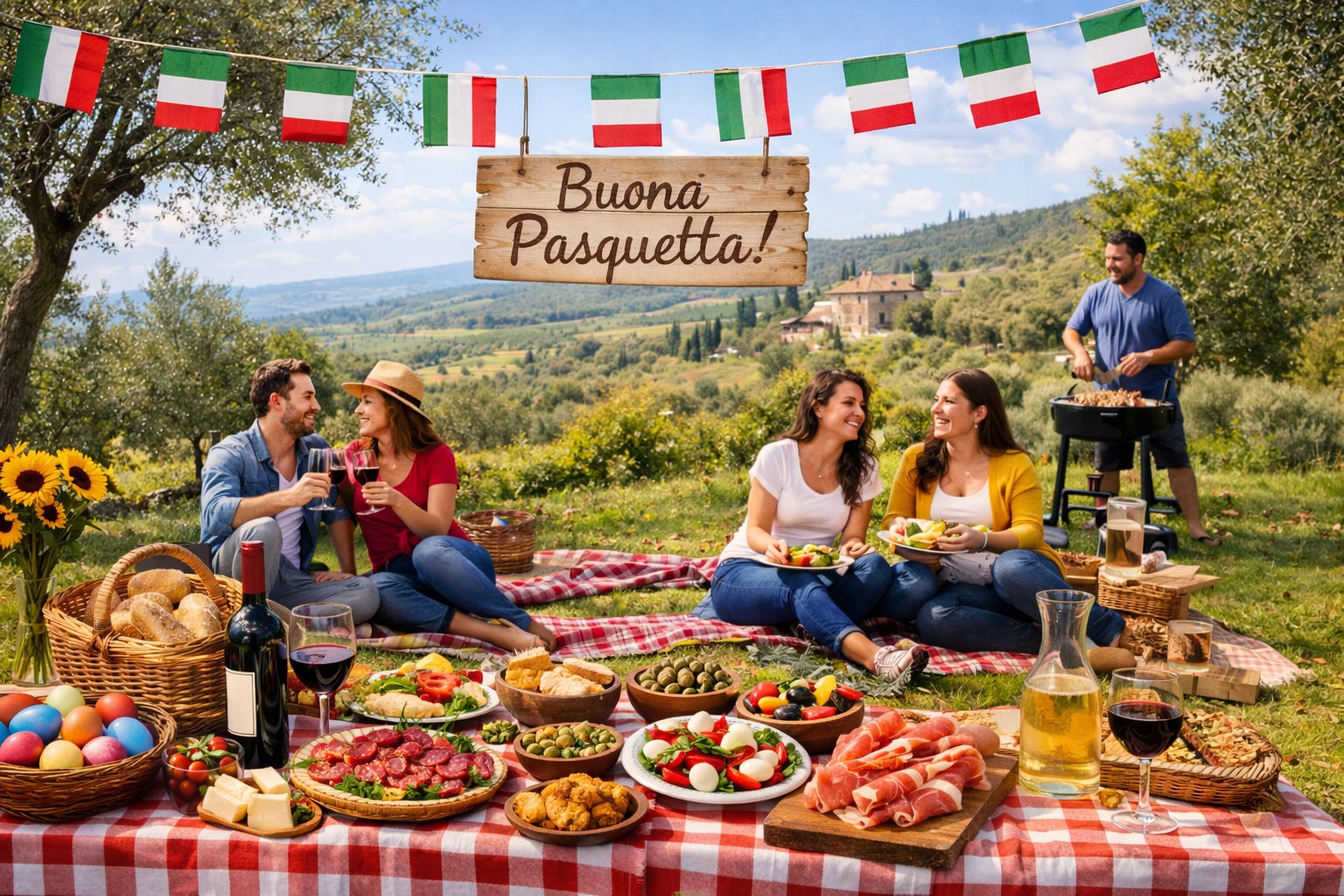
Friends:
Since we don’t celebrate this day here in the States, I like to share some details on what it is and the symbolism behind it.
Every year on the Monday after Easter Sunday, Italy undergoes a quiet but unmistakable transformation. Roads empty of their usual urban bustle, parks fill with laughter, and the smell of grilling meat drifts across hillsides and riverbanks. This is Pasquetta — literally “Little Easter” — a celebration that is at once ancient and deeply modern, sacred in its origins and exuberantly secular in its expression.
The Name and Its Diminutive Tenderness
The word Pasquetta is itself telling. It is the affectionate diminutive of Pasqua, the Italian word for Easter. This linguistic choice reveals something essential about the holiday’s character: it is smaller, lighter, freer than the solemnity of Easter Sunday. Where Pasqua is the day of the Resurrection, of Mass and family duty, Pasquetta is its joyful exhale — the moment the community steps outside, both literally and spiritually.
This diminutive quality has never diminished the celebration’s importance. Pasquetta has been a public holiday in Italy since the Lateran Treaty of 1929, when the Catholic Church and the Italian state forged their modern relationship, enshrining the day in the nation’s official liturgical and civil calendar.
Roots in the Sacred: The Walk to Emmaus
The theological root of Easter Monday lies in one of the most poetic passages in the Gospel of Luke — the Road to Emmaus. In this story, two disciples, confused and grieving after the Crucifixion, walk from Jerusalem to the village of Emmaus. A stranger joins them on the road and speaks with them at length; only when they sit down to break bread together do they recognize him as the risen Christ, who then vanishes.
This narrative of walking, companionship, and communal meal is the spiritual architecture upon which Pasquetta is built. The tradition of going fuori porta — literally “outside the gate,” beyond the city walls — mirrors the disciples’ journey. Italians leave their homes and cities on this day not merely for recreation, but in an unconscious echo of a centuries-old pilgrimage. The walk itself is the prayer; the shared meal is the eucharist reinterpreted in olive oil and red wine.
In many Italian towns, the day still includes religious processions where the statue of the risen Christ is carried outdoors, as if to enact His emergence from the tomb into the open world.
The Picnic as Ceremony
The heart of Pasquetta is the gita fuori porta — the outing beyond the city. Families and groups of friends pile into cars, pile onto bicycles, or walk to the nearest green space: a park, a hillside, a vineyard, a beach. The destination matters far less than the act of departure.
What follows is the ritual of the picnic, and in Italy, even a picnic carries the weight of ceremony. The food brought to these outdoor gatherings is deeply symbolic and deeply regional.
The colomba pasquale — the Easter dove-shaped cake — appears on almost every blanket. Its form is no accident: the dove carries centuries of symbolism, representing the Holy Spirit, peace, and renewal. Dusted with pearl sugar and almonds, it is sweet in the way spring itself is sweet.
Hard-boiled eggs, colored or plain, are essential. The egg is perhaps the most universal symbol of Resurrection, of potential sealed within a fragile shell. In Pasquetta, children roll them down hillsides, crack them against each other in playful competitions, and eat them with salt and wonder. In some Southern Italian traditions, elaborately decorated Easter eggs made of chocolate or sugar are exchanged as gifts, and cracking them open on Pasquetta morning is a rite of its own.
Lamb, too, has its place at the table — another resonance with the Christian Paschal lamb, the Agnus Dei. Roasted or grilled, it appears in forms that vary by region: Roman abbacchio, Sardinian lamb on a spit, Neapolitan ragù with egg pasta.
Regional Variations: A Mosaic of Customs
Italy’s extraordinary regional diversity means that Pasquetta is not one celebration but twenty, each flavored by local geography and tradition.
In Tuscany, the occasion is synonymous with the rolling countryside — the campagna — and a long afternoon among vineyards and cypress trees, with Chianti poured liberally, and ciaccia flatbread passed around. In Rome, the Castelli Romani — the volcanic hills south of the city — traditionally draw hundreds of thousands of Romans who come to drink the local white wine and eat porchetta. This legendary herb-roasted pork is almost a religion of its own.
In Sicily, Pasquetta is accompanied by elaborate sweets: cassata sponge cakes layered with ricotta and candied fruit, and agnello di pasta reale — lamb-shaped marzipan — whose appearance on the table is a feast of symbolism in miniature. In Naples, families gather along the seafront or head to the hills of Campi Flegrei, where ancient volcanic craters serve as picnic grounds, the earth itself seeming to breathe with the seasons.
In the Alpine north, where spring arrives with more hesitation, Pasquetta may be celebrated indoors still, but always in large company — the communal spirit overriding the weather.
Friendship, Freedom, and the Open Air
What binds all these regional variations together is an ethos that goes beyond religion or gastronomy. Pasquetta is fundamentally a celebration of collective freedom. In the Christian agricultural calendar that shaped Italian culture for over a millennium, the winter and the Lenten season represented restriction, scarcity, and interiority. Easter was the hinge — and Pasquetta was the door thrown open.
Going outside together is an act of communal renewal. The sky above, however cloudy, is wider than any ceiling. The grass underfoot is more honest than any floor. On Pasquetta, Italians remind themselves that the world is large, that the body needs air and light and the company of people one loves, and that a meal eaten on a blanket under an open sky tastes different — better, freer, more alive — than the same food eaten at any table.
There is also something quietly democratic about the tradition. The Pasquetta picnic requires no reservation, no dress code, and no special address. A plastic tablecloth on city grass in Milan holds the same spirit as a linen spread on an Umbrian hillside.
Modernity and the Living Tradition
Pasquetta has adapted with grace. In contemporary Italy, it is also the occasion for the first outdoor aperitivi of the season, for day trips to lesser-known towns or archaeological sites, for cycling routes and hiking trails, and impromptu concerts in public squares. Social media fills with images of prati fioriti — flowering meadows — and of groups squinting happily into the spring light.
Yet for all its modern inflections, the core of the celebration remains remarkably intact. Italians on Pasquetta are still, in some sense, walking the road to Emmaus — moving through the spring world, talking, uncertain perhaps of where they are going, but nourished by companionship and ready, at the end of the journey, to recognize something sacred in the breaking of bread.
Pasquetta falls on Monday, April 6, this year — today — and across Italy, millions of people are already spreading their blankets on the grass.