

Friends:
In the peaceful hills of early medieval Europe, around the year 610, a monk was alone in a stone kitchen with only flour, water, and salt. During Lent, his little community—maybe in the Lombard foothills of northern Italy or close to the present-day French border—had emptied its pantry of everything that could offer comfort or richness. There were no eggs, no butter, and no milk. The monk’s world had been pared down to its most necessary necessities, and yet this limitation would prove to be the starting point of invention.
He was no man with grand ambitions. The bells determined the rhythm of his daily routine, summoning him from prayer into work and then back to prayer once more. On that afternoon, with the pale winter light filtering through a narrow window, his attention turned to the children who were inside the nearby dim chapel. They fidgeted and had difficulty remembering their prayers, their faces tight with concentration and their lips moving over words which they hardly understood. The monk observed them and an idea began to take shape in his mind.
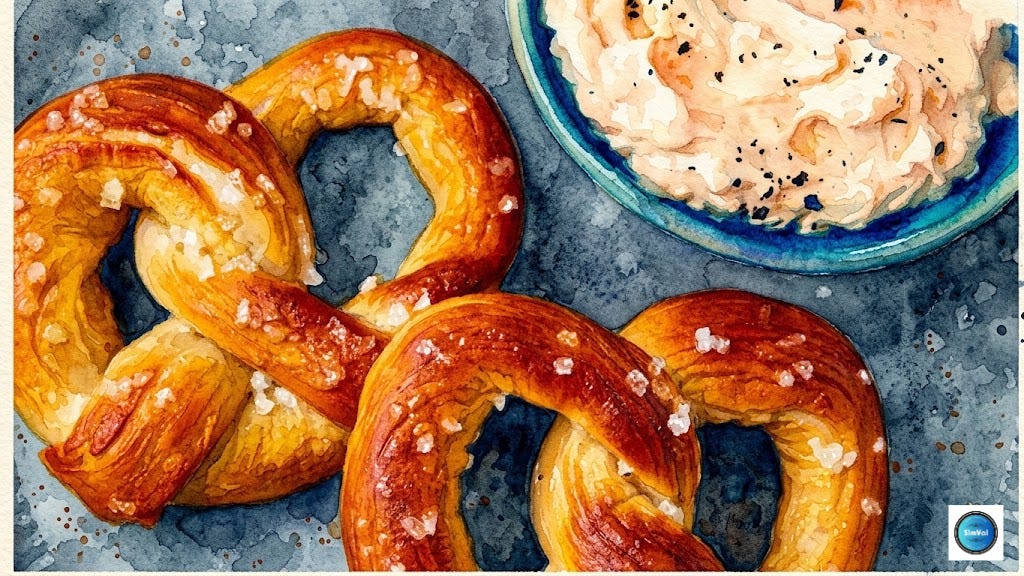
He started to roll the simple mixture into long, thin strips, the sort of soft ropes that can be shaped between experienced hands. Next, he made each strip into a loop — arms folded over the chest, just as a penitent does when folding themselves in prayer, with the hands placed on the opposite shoulders. He put the finished items into the oven and waited, hearing the distant sound of the children reciting. When he removed them, they had golden edges and smelled slightly of the clean aroma of baked grain.
He called the children to him, put the twisted shapes into the hands that were outstretched by them, and indicated the three open areas made by the loops—the three ‘holes’ in the Bread, the three windows in the dough—and in a quiet voice told them that those things stood for the Holy Trinity: the Father, the Son, and the Holy Spirit. “These are your pretiola,” he said, since pretiola is Latin for “little rewards”. “As a reward for your faithful hearts.” The children smiled. The lesson had taken a form that they could hold.
Basically, the story of the pretzel is about converting an abstract concept into something tangible. Abstract ideas took the form of edible food that could be carried in one’s pocket and shared with friends. The news of the monk’s edible teaching method spread slowly, traveling along the same routes that connected monasteries throughout medieval Europe. The traveling friars would put the twisted breads in their baskets with the alms and give them to people in need at the monastery gates. In a society where most people were illiterate, the pretzel’s shape by itself conveyed a lesson – it was a visible and edible catechism.
From the beginning, manuscript illuminators began adding small drawings of the braided snack in the margins of their books, an affectionate and ordinary detail that appeared in sacred texts alongside images of rabbits and flowers. The Latin term bracellae, which means “little arms”, was softened in German speech and eventually changed to brezitella before reaching the form we use today. By the High Middle Ages, the bakers’ guilds stretching from Alsace to Bavaria had adopted the pretzel as their emblem – a sign displayed outside shops that made clear what craft was carried on inside. The shape had outlived its inventor by several centuries and would continue to outlive the guilds themselves.
The disciplined creativity which had resulted in the invention of the pretzel was also present in the stone dairy rooms of French and Italian abbeys. The monks, having risen before dawn to say their morning prayers, would go directly from the chapel to the cowshed. In the Cistercian communities in Burgundy during the twelfth and thirteenth centuries, the monks developed a sort of science concerning fermentation and treated milk with the same care as they did their illuminated manuscripts.
So, again let’s imagine a monk in a cool, vaulted room with a smell of wood and whey. He carries out his work calmly and efficiently, warming the fresh milk both by touch and by measurement, pouring in the rennet to set it, and then cutting the curd with a long-handled knife in even, steady strokes. The task is repetitive and almost meditative, in keeping with the Cistercian belief that manual labor is a form of contemplation. Although his hands are moving, his mind remains quietly focused.
The cheeses produced by these early techniques are the ancestors of those we eat nowadays. The monks at the Abbey of Cîteaux have for over seven hundred years been making a soft cheese with an orange rind and a strong odor using the same methods. Brie de Meaux, which is creamy and pale with a white border, is made by Benedictine monks near Paris, who discovered that aging the curds in cool cellars could turn a short-lived product into a durable one. The golden or ivory rinds on these cheeses were not merely for appearance; they indicated the time and care that had been invested in turning a common product into a special one.
Cheeses had uses that went beyond being eaten; since there was no refrigeration, cheese that had been aged stored up energy in the summer to use in winter. It also acted as a form of currency, as monasteries would sell cheese at market fairs, and the money thus earned was used not only to support the monks but also to support hospitals, orphanages, and schools that relied on the church. Thus cheese cellars became an element of the social structure in medieval Europe.
In the more northern areas of what is now Belgium, a different monastic tradition was gradually taking shape. The Trappist monks—that is, members of the Order of Cistercians of the Strict Observance, so named after the French abbey of La Trappe—had inherited a great deal of knowledge concerning brewing and took this knowledge with them to the Low Countries, where the soft water and the cool cellars were perfectly suited for producing ale.
The brewery in a Trappist abbey is all about working hard. It has very little decoration, and the copper kettles are both large and practical. The monks work in almost total silence, just as they do elsewhere in their daily routine. The only conversations they have are those that are necessary, for example asking about the temperature or making a note regarding a particular batch. Nevertheless, the beer produced here is by no means ordinary. Ales from abbeys such as Westvleteren, Chimay, Westmalle, and Rochefort are among the most complex and in-demand beers in the world. They can be deep amber or nearly black, with flavors of dark fruit, toffee, spice, and earth, or golden and carbonated, with the smell of hops and honey. Each beer is the outcome of centuries of small improvements, all made by monks who were more concerned with perfecting their craft than with gaining fame.
The seal known as the Authentic Trappist Product is administered by the International Trappist Association and is awarded only to beers produced within a Trappist monastery under the direct oversight of the Trappists, with the proceeds being used to support the monastic community or for charitable purposes. This certification enables genuine Trappist beers to be distinguished from commercial versions that merely copy the appearance without sharing the underlying values. For the Trappists, brewing has never been about making a profit; it has instead been a means of supporting a way of life based on prayer, simplicity, and service, as well as helping the communities surrounding the abbey.
Of the various gifts that monasteries have contributed to the world, perhaps the most mysterious is the liqueur produced by the Carthusian monks of the Grande Chartreuse, who are located in the Alps to the northeast of Grenoble. In 1605, a French army marshal is said to have given the monastery a worn parchment manuscript, attributed to a sixteenth-century alchemist and claiming to show how an “elixir of long life” can be made from 130 different plants—namely herbs, roots, bark, flowers, and seeds taken from Alpine meadows and distant gardens. For over a century, the manuscript remained only partially understood; it was not until 1737 that a monk named Frère Jérôme Maubec managed to decipher the formula and begin making the liqueur.
No one has ever completely managed to reproduce Chartreuse, whether the bright green variety with its intense mountain aroma or the milder, honey-coloured yellow one; only two monks at a time know the precise mixture of plants, the procedure for soaking them and the timing for distillation — a practice which has been maintained for centuries as a sacred trust. Originally the liqueur was used as a medicine and was given to sick travelers and to people in need at the monastery’s gate. Later on, it became a complex drink that people enjoyed for both pleasure and its healing properties, and it was appreciated throughout Europe by those who could afford its unique taste.
What is most striking about Chartreuse is not merely its secrecy, although that is impressive, but rather its continuity. The same monks, in the same valley, having used the same manuscript, have been producing the drink for nearly three hundred years. When the French government expelled the religious orders and seized the distillery in 1903, the monks went to Tarragona, Spain, and continued making Chartreuse until they could return. The liqueur remained with the community, not with the building. The recipe was kept in memory and by faith, just as prayer is portable.
What the Monks Left Behind
From century to century and across various crafts, the same idea has connected the monk shaping dough in 610 with the Trappist production of ale today. This piety is not merely abstract; it is piety expressed through careful, steady, and repeated work. The medieval monastery, in many respects, functioned as a laboratory—a place where the same task was carried out every day, with a sufficient degree of consistency to observe changes, enough humility to record them, and sufficient discipline to pass them on. The pretzel helped children to learn how to pray by giving them the doctrine in their hands. Cheese provided food for the communities during harsh winters, the beer financed the chapels, hospitals, and schools, and the liqueur cured the sick and preserved a part of the herbal knowledge which might otherwise have been lost.
They are more than merely romantic notions; they are facts which can be found in the foods themselves—such as the three holes in a soft pretzel, the amber rind of Cîteaux cheese, the dark sediment in a Westvleteren bottle, and the strange green color of a glass of Chartreuse. All of these are evidence of a way of life based on the idea that simple work, carried out with care, is never really simple. Gradually, it turns into something that outlasts the person who made it—a gift passed on through the centuries and which remains as warm as ever.
References
Smith, K. A., 2026, Making and Breaking Bread in the Medieval Monastery, Church History, https://doi.org/10.1017/S0009640726000190
Nelson, M. (2018) ‘Celtic and Egyptian Beer-Production Traditions and the Origins of Western European Monastic Brewing’, Journal of Medieval Monastic Studies, 7(1), pp. 47–77. https://doi.org/10.1484/J.JMMS.5.116565
S. Pruitt, History.com, April 23, 2015. The Pretzel: A Twisted History. https://www.history.com/articles/the-pretzel-a-twisted-history
Smith, K. A. (2026), ‘Making and Breaking Bread in the Medieval Monastery’, Church History, pp. 1–21. https://doi.org/10.1017/S000964072610331X
S. Pruitt, History.com, April 23, 2015. The Pretzel: A Twisted History. https://www.history.com/articles/the-pretzel-a-twisted-history
S. Pruitt, History.com, April 23, 2015. The Pretzel: A Twisted History. https://www.history.com/articles/the-pretzel-a-twisted-history
S. Pruitt, History.com, April 23, 2015. The Pretzel: A Twisted History. https://www.history.com/articles/the-pretzel-a-twisted-history
Pretzel - Etymology, Origin and Meaning. Etymology Online. https://www.etymonline.com/word/pretzel
Brie de Meaux is explained on Everything Explained Today. https://everything.explained.today/Brie_de_Meaux/
M. Cartwright (2019), ‘Trade in Medieval Europe’, World History Encyclopedia, available at https://www.worldhistory.org/article/1301/trade-in-medieval-europe/
(2024) Trappist breweries in The Oxford Companion to Beer. Available at https://www.beerandbrewing.com/dictionary/Qm5QvPgkZe
Clarke, W., 2026. The Famous Five - Trappist beers. Beer Pages. Available at https://www.beer-pages.com/stories/trappist-beers.html
(n.d.). Genesis. Chartreuse 1605. Chartreuse 1605. https://www.chartreuse1605.com/en/genesis/
(2024). Chartreuse Liqueurs. Food Reference Beverage Facts. Food Reference. https://www.foodreference.com/html/artchartreuseliqueurs.html
S. Tadié, August 19, 2021. The Story Behind Chartreuse, the Legendary Liqueur of the Carthusians. National Catholic Register. https://www.ncregister.com/blog/chartreuse-liqueur
(n.d.). Chartreuse (liqueur). Wikipedia. https://en.wikipedia.org/wiki/Chartreuse_(liqueur)
(2023). Cîteaux. Abbaye de Cîteaux. https://citeaux-abbaye.org/
Voelkle, W. (May 1, 2011). Pretzels at the Last Supper? The Morgan Library & Museum. https://www.themorgan.org/blog/pretzels-last-supper
S. Pruitt, History.com, April 23, 2015. The Pretzel: A Twisted History. https://www.history.com/articles/the-pretzel-a-twisted-history