

Ah, the sacred Italian rule of Ferragosto: we work 10 months, get paid for 12, and on today, August 15, we collectively ghost the entire country like it’s a bad Tinder date. Shops shutter, offices go dark, and the only souls left wandering our piazzas are confused tourists clutching maps in one hand, looking for a cappuccino at 3 PM, and melting gelato in the other. Meanwhile, we natives have synchronized our watches to “beach o’clock,” abandoned our cities to selfie sticks, and are lying motionless under an umbrella, contemplating whether answering that work email constitutes a criminal offense (spoiler: it does). Why waste a national holiday being productive when we’ve spent the other ten months perfecting the art of looking busy to earn this glorious stretch of nothing?
Ferragosto is not merely a holiday; it is a feeling—a collective exhale after months of work, a celebration of summer at its most golden and generous. It is the day when families gather under the shade of pine trees or beach umbrellas, when the air smells of salt and grilled food, and when time itself seems to slow down. Let’s see how it started.
The tradition is ancient, born long before any modern calendar. It began as a moment of rest for people and land, a pause granted after the heavy labor of the harvest. Over the centuries it absorbed new meanings and rituals, but its heart never changed: Ferragosto is about stopping, being together, and honoring the season’s abundance. The Catholic Church later placed its own feast on the same date, yet for most Italians the day remains deeply secular—a national permission slip to abandon routine and embrace leisure.
In the central and southern regions, Ferragosto is lived with particular intensity. The holiday is incomplete without a long, lazy lunch that stretches into the late afternoon, accompanied by laughter, wine, and the slow rhythm of conversation. Every region adds its own touch: a rich fish soup in the Marche, cool watermelon jelly in Sicily, baked pasta in Puglia, or, in some Calabrian families, the old custom of a midnight swim before the feast.
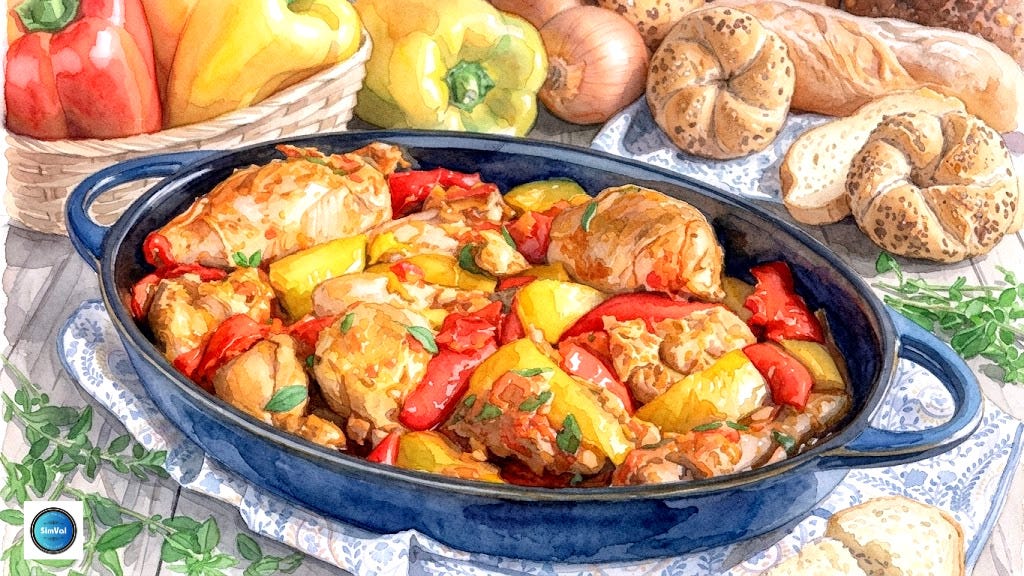
Amid all this variety, one dish stands out as the true emblem of Ferragosto in the center and south: chicken with peppers. It is a humble plate, born from the kitchens of everyday people who knew how to turn simple ingredients into something unforgettable. The chicken is succulent, the peppers sweet and slightly charred, and the sauce that forms around them so deeply flavored that no one can resist sopping it up with crusty bread. This is food that tastes of memory, of summer gardens, and of the patient, unhurried cooking that defines Italian home life. This dish reminds me of my summer days as a teenager, when my mother brought it to the shores of the Adriatic in Abruzzo and served it cold on a beach-temperature day, along with the rice salad with canned tuna.
Making this dish at home brings a little piece of Ferragosto to your own table. The process is straightforward, but it asks for care and attention, just like any good summer ritual. Here is a good recipe to make it.
The Classic Chicken with Peppers (Pollo con Peperoni)
Serves 4 to 6 people
You will need:
One whole chicken, about 1.5 kilograms, cut into serving pieces, or roughly 2 pounds of chicken thighs if you prefer
Three large bell peppers, preferably red and yellow for their natural sweetness
One medium onion or a shallot, finely chopped
One clove of garlic, left whole but lightly crushed.
One cup of dry white wine
One can of tomato puree, about 400 grams, or six ripe San Marzano tomatoes, roughly chopped.
Extra virgin olive oil, enough to generously coat the pan
Fine salt and freshly ground black pepper
Optional, for a Roman-style warmth: one teaspoon of turmeric and a pinch of dried chili pepper
Procedure
Begin by washing the chicken pieces and patting them completely dry with paper towels. This step matters more than you might think—dry skin browns beautifully, while wet skin steams. Season the chicken all over with salt and pepper.
Place a large, heavy-bottomed pan or casserole dish over medium heat and pour a decent amount of olive oil. When the oil shimmers, add the chicken pieces in a single layer, being careful not to overcrowd the pan. If necessary, work in batches. Let the chicken brown slowly and undisturbed for several minutes on each side, until the skin turns a deep, golden amber. Remove the browned chicken and set it aside.
Return the pan to the heat if needed, then add the whole garlic clove to the oil and let it sizzle for a minute, releasing its fragrance. Then pour in the white wine. It will hiss and bubble—this is good. Let it cook until the wine has almost completely evaporated, using a wooden spoon to scrape every browned bit from the bottom of the pan. Those tiny caramelized pieces are liquid gold.
Now add the chopped onion and let it soften gently for a few minutes. While the onion cooks, wash the bell peppers, remove the stems and seeds, and slice them into thick strips about two centimeters wide. Add the pepper strips to the pan, followed by the tomato puree or the chopped fresh tomatoes. Stir everything together until the peppers are coated in the red sauce.
Pour in about half a cup of warm water, just enough to create a loose sauce. Return the browned chicken to the pan, nestling the pieces into the peppers and sauce. Cover the pan with a lid, reduce the heat to low, and let everything simmer for about forty-five minutes. Stir occasionally, checking that the sauce does not dry out—if it seems too thick, add a splash more hot water. The chicken is ready when it is fork-tender and nearly falling off the bone, and the peppers have softened into silky, sweet ribbons.
If you are using the turmeric and chili, sprinkle them in during the last ten minutes of cooking, stirring well to distribute their warm, earthy color and gentle heat.
To serve:
Transfer the chicken and peppers to a large serving dish, spooning all that rich, rust-colored sauce over the top. The only accompaniment you truly need is a basket of crusty country bread. Place it on the table and watch as every guest tears off a piece to mop their plate clean—this is the ritual of scarpetta, and it is as much a part of the meal as the chicken itself. Serve it warm, preferably outdoors, with a glass of chilled white wine and the lazy afternoon stretching ahead of you. In that final, easy silence, the meal delivers its true payoff: simple food, shared well, and the feeling of summer lingering just a little longer.
Ferragosto is many things: a historical echo, a religious feast, a summer escape. But above all, it is a day dedicated to the simple pleasures of life—good food, warm company, and the awareness that sometimes the greatest luxury is doing nothing at all. And on that day, in kitchens across central and southern Italy, the scent of chicken and peppers drifting through open windows is the soundless music of a country at peace with itself.
That is the final payoff of Ferragosto: a shared table, an unhurried afternoon, and summer felt at its fullest. Maybe we should all adopt the Italian way of living after all!
References
“Ferragosto in Italy: Origins and Traditions.” Italy Magazine. https://www.italymagazine.com/dual-language/ferragosto-italy-origins-and-traditions Accessed August 13, 2026
“Ferragosto.” EWTN News Nightly, August 14, 2023. (Video)
Bennetts, Stephen. “Tradizione e contaminazione”: an ethnography of the contemporary Southern Italian folk revival.” University of Western Australia, 2006. https://doi.org/10.26182/5f1a-0b1a
Feinstein, Paul. “Ferragosto Food Traditions: From Ancient Rome to Modern Italian Feasts.” Fine Dining Lovers, August 13, 2025. https://www.finedininglovers.com/explore/articles/ferragosto-food-traditions-history-italian-feasts
Feinstein, Paul. “Ferragosto Food Traditions: From Ancient Rome to Modern Italian Feasts.” Fine Dining Lovers, 2025. https://www.finedininglovers.com/explore/articles/ferragosto-food-traditions-history-italian-feasts Accessed August 13, 2026
Feinstein, Paul. “Ferragosto Food Traditions: From Ancient Rome to Modern Italian Feasts.” Fine Dining Lovers, 2025. https://www.finedininglovers.com/explore/articles/ferragosto-food-traditions-history-italian-feasts Accessed August 13, 2026
“Ferragosto: History and Culture Behind This Typically Italian Holiday.” Tuscany Travel Experience, 2025. https://www.tuscanytravelexperience.com/ferragosto-history-italian-holiday/ Accessed August 13, 2026
Capatti, Alberto, and Massimo Montanari. Italian Cuisine: A Cultural History. Columbia University Press, 2003. https://www.jstor.org/stable/10.7312/capa12232